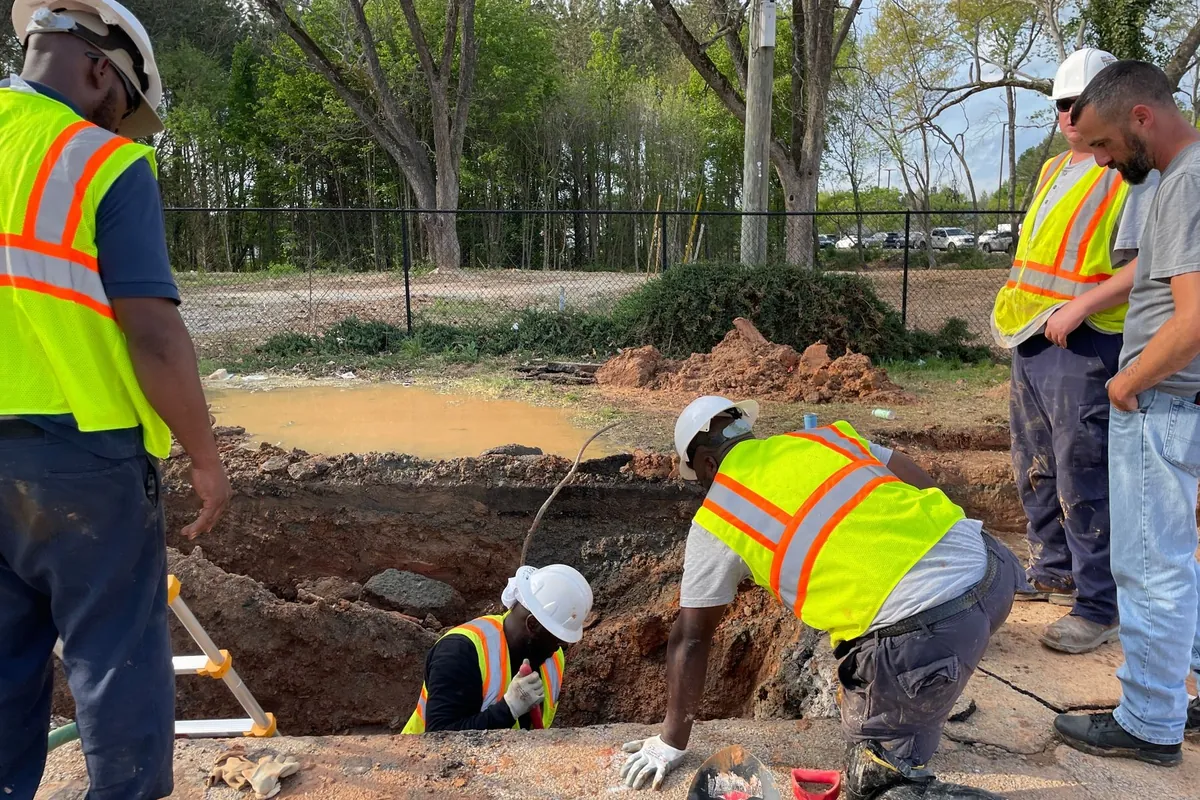
When a city water main breaks and floods your basement in Ohio, the cost can land in three places: your own homeowners insurance, a damage claim against the city, or both. Ohio law treats running a municipal water system as a “proprietary function,” and a city can be liable for loss caused by the negligent performance of that function, but it is not automatically liable for every break. Whatever the answer turns out to be, the first steps do not change: report the break, protect yourself from the water, document everything, and get the basement dried within a day or two.
Water pouring into the basement?
Stay away from wet outlets and the furnace, report the break to the city, then call: a partner call service checks which participating restoration companies serve your part of Ohio, so you can ask about water removal and drying directly. Nothing is booked unless you agree.
Step 1: report the break
A main break is the city’s emergency to fix, and the sooner it is reported, the sooner the water is shut off. Numbers we confirmed on official pages on November 13, 2026:
| City | To report a water main break |
|---|---|
| Columbus | 311 (614-645-3111) or 614-645-8276 on weekdays 7 a.m. to 6 p.m.; 24-hour Water Distribution Maintenance desk after hours: 614-645-7788 (City of Columbus) |
| Dayton | Water emergency line 937-333-4900, 24 hours a day; dispatch 937-333-4905 (City of Dayton) |
| Elsewhere in Ohio | Your water utility’s emergency number is usually on your water bill. If water threatens power lines or gas equipment, call 911. |
Step 2: make the basement safe and document it
- Do not walk into water that reaches outlets, cords, the furnace or the water heater. Switch off power to the basement from a dry spot, or have the utility or an electrician do it.
- Photograph and video before cleanup: water depth, where it is entering (wall, floor drain, window well), the street and the break site if you can do it safely.
- Write down times: when the water started, when you reported it, the name or ticket number you were given, and when crews arrived.
- Keep damaged items until your insurer or the city says you can discard them, and keep every receipt.
Step 3: get the water out and the basement dry
Water main water usually arrives clean, but it picks up dirt and debris on the way in. The EPA says to dry water-damaged areas and items within 24-48 hours to prevent mold growth (EPA, A Brief Guide to Mold, Moisture and Your Home). That timeline does not wait for the claim to be decided. A restoration provider extracts standing water, removes wet carpet pad, drywall and insulation that cannot be dried, and runs dehumidifiers and air movers with daily moisture readings, which also gives you a record for the claim. Our guides to water mitigation in Ohio and basement flooding cleanup explain the process.
Basement flooded by a broken main? Call (844) 434-2077 to check which participating water removal and drying providers serve your address. A partner call service answers; we may be paid when you call.
Who pays? What Ohio law says
Ohio’s Political Subdivision Tort Liability Act, Ohio Revised Code chapter 2744, separates “governmental” functions from “proprietary” ones. Three provisions matter here (text checked against a current published copy on November 13, 2026, because codes.ohio.gov did not load that day):
- R.C. 2744.01(G)(2)(c) lists “the establishment, maintenance, and operation of a utility,” including “a municipal corporation water supply system,” as a proprietary function. Section (G)(2)(d) adds “the maintenance, destruction, operation, and upkeep of a sewer system.”
- R.C. 2744.02(B)(2) says political subdivisions are liable for injury, death, or loss to person or property “caused by the negligent performance of acts by their employees with respect to proprietary functions,” subject to the defenses in R.C. 2744.03.
- R.C. 2744.04(A) requires an action against a political subdivision for such a loss to be brought within two years after the cause of action accrues.
The key word is negligent. A city is not liable just because its pipe broke; the question is whether the break or the response involved negligence. That is a factual and legal question, and if the loss is large, it is worth asking an Ohio attorney.
Filing a damage claim with the city
Most cities have a claim form for damage from city infrastructure. Two examples:
- Columbus: the city says it will not open a claim or begin an investigation until a completed claim form is received; utility claims are handled at 614-645-6261 (City of Columbus, File a Claim).
- Cleveland: the Department of Law handles claims; the city says it is not required to pay any amount covered by insurance (it can reimburse your deductible if you have coverage), processing can take up to 12 weeks, and the decision comes in writing (City of Cleveland, Requests & Claims).
Cleveland’s rule shows why your own insurer usually comes first: if your policy covers the loss, the city may only consider the deductible. For Cleveland-area basements, see our Cleveland water damage page; for Columbus, our guide to flooded basement cleanup in Columbus.
Your homeowners policy and flood insurance
Whether your homeowners policy covers water from a broken city main depends on its wording, especially how it treats water that enters from outside the house at or below ground level. Read the water damage and exclusions sections and call your agent. Flood insurance has its own definition: FEMA defines a flood as a general and temporary condition of partial or complete inundation of two or more acres of normally dry land or of two or more properties, at least one of which is yours (FEMA, NFIP Terminology Index). A large main break that floods several properties may meet that definition; one that floods only your basement usually will not. FEMA’s FloodSmart site, discussing burst hydrants, says coverage depends on how much water spreads to surrounding areas. Our page does insurance cover water damage in Ohio? has more.
Is it the main or your service line?
Not every gusher in the yard is a main break. Cities usually make the owner responsible for the service line on the private side. Columbus says the owner is responsible for repairing yard leaks (City of Columbus, Water Leaks), and Dayton says the service line from the curb stop to the meter is the homeowner’s responsibility. If the city crew tells you the leak is on your side, the repair is a plumber’s job and the claim goes to your own insurer.
Frequently asked questions
Who pays when a city water main floods my basement in Ohio?
Often your homeowners insurer first, depending on your policy. The city may be liable if the loss was caused by negligence in operating its water system, a proprietary function under R.C. 2744.01 and 2744.02.
How long do I have to sue a city in Ohio over water damage?
R.C. 2744.04(A) sets two years after the cause of action accrues. City claim forms may have their own timelines; file promptly.
Will the city pay my deductible?
Some cities consider it. Cleveland says it is not required to pay amounts covered by insurance and can reimburse a deductible.
Is a water main break a flood for insurance purposes?
Only if it meets the flood definition, which involves two or more acres or two or more properties. Ask your insurer how your policy classifies it.
Should I wait for the claim before drying the basement?
No. Document first, then dry. The EPA says to dry within 24-48 hours to prevent mold growth, and drying records support the claim.
Sources consulted November 13, 2026: Ohio Revised Code sections 2744.01, 2744.02 and 2744.04 (current text checked on a published copy; codes.ohio.gov unavailable that day); City of Columbus, Report a Water Main Break, Water Leaks and File a Claim; City of Dayton, water service pages; City of Cleveland, Requests & Claims; FEMA, NFIP Terminology Index and FloodSmart; U.S. EPA, A Brief Guide to Mold, Moisture and Your Home. General information, not legal or insurance advice.
Talking to a cleanup provider
waterdamagefirstresponse.com does not perform restoration or plumbing work and does not employ technicians. If a water main break or any other leak has flooded a basement in an Ohio home, call (844) 434-2077: a partner call service checks whether a participating provider serves your area. You decide whether to move forward with anyone you speak to.